Developing a Christian Worldview

I like the explanation of worldview as being how you think when you aren’t really thinking. It is sort of like the operating system of a computer … our operating system of underlying thought. This system needs to be aligned with God’s thoughts if we are to see life clearly and teach effectively.
Worldview is formed by our experiences and culture.
“Do not conform to the pattern of this world but be transformed by the renewing of your mind.” – Romans 12:2[1]
The verse starts with warning against being conformed to how the world thinks, because we live in the world with its pervasive culture influencing how we see things.
Developing a Christian worldview is the process of aligning our belief system with God’s word. The process of renewal requires that we allow the light of God’s truth to show us what is false in our thinking and to intentionally replace these views with the way God sees things. This will also give us the ability to discern what is true or false in what we encounter, including the content of the curriculum we teach.
This makes sense to me, since I had 25 years of developing a culturally formed worldview that didn’t include God before I received Christ. I had to then gradually adjust my beliefs about almost everything. Even now, after years of Bible studies and sermons, readings and discussions, I occasionally discover that I am holding old habits of thought patterns that are not in line with the mind of Christ.
How we see things depends on where we stand.
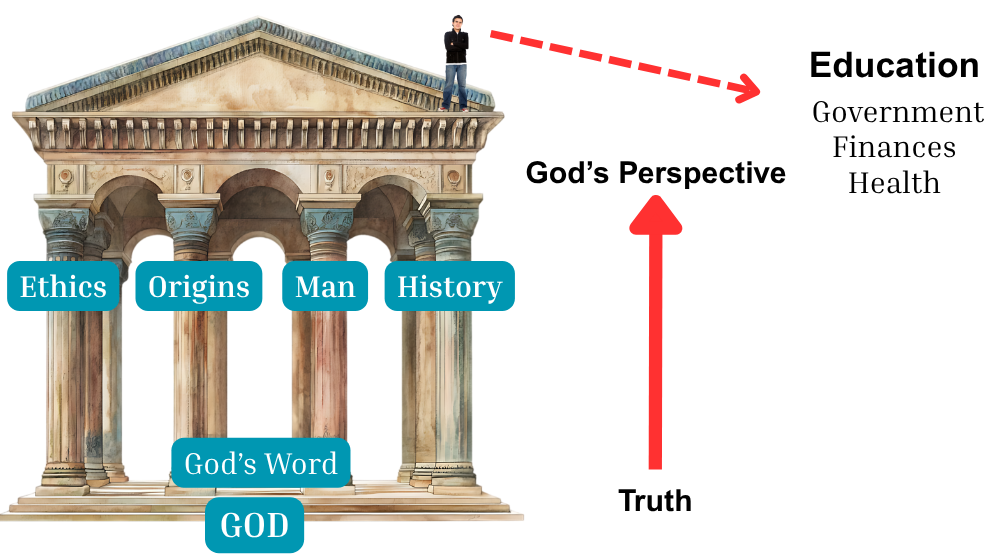 In the diagram to the right, we can see a man looking out from the top of a temple. His perspective and view of all of life is determined by where he stands.
The goal of developing a Christian worldview, we might say, is to stand with this guy on the roof of the temple and to see things from God’s perspective, based on His word, His truth. This view gives us insight and wisdom in all areas of life, allowing us to live fruitful and meaningful lives.
As teachers, our worldview will affect our philosophy of education − for example, the nature of learning, the goal of education, our view of the student, the role of the teacher, or classroom management. When this philosophy is solidly based on truth and not the latest trend of education, we will be more effective in helping students become all God intended. Since worldview is developed largely through experience, the culture that the teacher forms in the classroom will be instrumental in forming the students’ own worldviews.
Where we stand and view the world is determined by our understanding of several broad areas of thought, represented here by these four pillars. Our underlying beliefs about the nature of reality are formed here and, in turn, will form our thoughts, values, attitudes and actions. To achieve the vantage point of God’s perspective on teaching, we must have each of these pillars built on the foundation of God and His Word. Our task is to continuously allow His Word to shape our thoughts in these areas.
Establish our underlying beliefs about the nature of reality.
Two questions that will help in the process of developing our worldview are
- What does God say about each of these areas?
- How does this understanding affect my teaching?
Let’s take a brief look at each of these four areas of thought and see how Scripture affects our perspective of teaching.
Origins:
The entirety of Scripture assumes that there is a God. That He created everything is stated in any number of verses (Genesis 1:1, John 1:1). This underlying truth affects every aspect of life and every subject.
By standing on the idea that the creation reveals the nature and character of God the creator, we help students make this connection. Teaching the whole truth about any subject will include God.
Man:
The theme of the biblical story centers on God’s redemption of humanity: man made perfectly in God’s image, corrupted by sin, redeemed by the loving sacrifice of His Son Jesus to enjoy a restored relationship with the Father.
Because of this, we are motivated to be part of God’s great plan for each student. We stand on the idea that our students have great value and that they are worthy of pouring our life and love into them. In doing so, we walk the path of life with them to show them the Way, the Truth, and the Life.
Note: In creative access situations you can reveal to students the reality of God without ever using the name of Jesus. When you show them truth, righteousness, goodness, kindness or love, by who you are and how you teach, you point them to Christ.
History:
A Christian view of history has a beginning and an ending, and because it provides the context for redemption, it has a purpose. It recognizes that God enters the creation with power to affect our lives according to His will. That Jesus was raised from the dead in time and space is the hinge that history turns on and, more than any other event, affects how we view reality, including life after death.
All this adds meaning and value to everyday activity in the classroom. What we do there can have lasting and eternal consequences. It truly is a sacred space. That is why we solve disputes, encourage, follow through, mend relationships, pray, celebrate, set goals and work hard. We also help students face hardship, because we stand on the idea that God is good and in control of the events of their lives to bring good out of it.
Ethics:
The Gospel is not a moral code, but it contains one. In His word, God shows us that there is good and evil, right and wrong, and He calls us to love what is good and hate what is evil and fight against it. By the power of the Holy Spirit, we are to “rid ourselves” of the desires of the earthly nature and “clothe ourselves” with the fruit of the Spirit and act accordingly.[2]
We stand on the morality revealed in Scripture, and so we teach moral values by the way we act with our students and the way we react to right and wrong behaviour. For example, when one student pushes another, we confront and correct their behaviour. If we ignore it and say nothing, we teach everyone that this behaviour is okay. By instilling habits of respect and obedience, we form the groundwork for a relationship with God.
I have only included a few thoughts on what Scripture has a lot to say in these areas. Gaining God’s perspective is a lifelong process of aligning our thoughts with His. We want to stand on the revelation of the truth of His word and then bring that truth into the classroom.
Take some time to think about how you would express a biblical understanding of these four aspects and how you can incorporate that understanding into your teaching.
Bob Adams
Bob is a former Christian school teacher and principal. He has worked with TeachBeyond in the area of teacher education. He is especially interested in how to prepare teachers to make a difference in helping students be all that God created them to be. He and his wife Shirley now live in the Vancouver area of Canada but spend 3 months in Guatemala where they worked in Christian education for 20 years and where their daughter runs a Christian school.
[1] Scripture quotation taken from The Holy Bible, New International Version® NIV® Copyright © 1973, 1978, 1984, 2011 by Biblica, Inc. Used with permission. All rights reserved worldwide.
[2] See Ephesians 4, Colossians 3, and Galatians 5.
Photo Credits
Children at Computers. Shutterstock. Resized.
Perspective. B. Adams. Resized.

How many students will your gift reach today?
Every $75 reaches one student. Today, double matching funds help you reach three.

Your Next Chapter
Stories like this start with
someone saying yes.
Every roof, every classroom, every friendship begin when one person decides to step beyond. We'd love to walk with you as you conside what that might look like.
Related Stories