The Impact of Safeguarding on the Development of Students’ Biblical Worldview

The formation of students’ biblical worldview does not happen only through the formal curriculum or Bible classes, but, above all, through the culture that they experience daily at school. The way they are treated, listened to, corrected, and protected communicates, in a concrete way, what the institution really believes about God, about human beings, and about justice. In this sense, safeguarding is not just a set of administrative norms, but a practical expression of the Christian faith applied to the educational environment.
From a biblical standpoint, our responsibility begins with the doctrine of imago Dei, which states that all human beings are created in the image and likeness of God. This truth establishes the non-negotiable foundation of human dignity: each child and adolescent has intrinsic value, regardless of his or her academic performance, behavior, or family or socioeconomic background. When a school takes this doctrine seriously, it recognizes that no form of humiliation, coercion, undue exposure, or neglect can be justified as a pedagogical strategy or used in interpersonal relationships between students and educators or between students themselves. Protecting the holistic integrity of the student (physical, psychological, emotional, and spiritual) becomes, therefore, a natural consequence of a coherent biblical understanding of man.
The greatest commandment in Scripture reminds us that we are to love God above all else, and this love becomes visible in the fulfillment of the second commandment: to love our neighbor as ourselves. Safeguarding is a concrete expression of this love. Loving your neighbor means intervening in the face of bullying, not minimizing reports of suffering, not silencing victims, not relativizing abusive or problematic behavior, while also dealing with the aggressor. Students learn that the Christian faith is not just vertical devotion, but horizontal commitment to care and justice.
The principle of reciprocity, of doing to others what we would want them to do to us (and not doing to others what we would not want them to do to us), also plays an essential formative role in the construction of one’s biblical worldview. When a school promotes an environment where respect and empathy are practiced, it teaches, in daily life, that relationships should be marked by mutual consideration and responsibility. On the other hand, when injustice is ignored or normalized, the message conveyed is distorted, and students feel belittled, marginalized, and invisible.
Therefore, it is essential that schools and teachers take a clear stand against injustice and in favor of righteousness, as an expression of the values of the Kingdom of God. Inaction in the face of wrongdoing communicates as much as action; Therefore, institutional integrity is part of Christian witness.
In addition to biblical responsibility, schools also have a social and civil responsibility. The implementation of clear safeguarding policies and the proper keeping of incident records demonstrate that the school takes seriously its obligation to protect the rights of children and adolescents. This reveals that the institution is neither indifferent nor negligent but committed to ethical and legal standards of care. Structure, protocols, and records are not mere bureaucratic formalities; they are tools to sustain a culture of responsibility and transparency.
By doing everything possible to protect children and adolescents from violent or unsafe environments, a school creates real conditions for them to flourish. Meaningful learning requires emotional security. Healthy development requires trust. When students feel protected, they are able to focus energy on academic, social, and spiritual growth. Protection and development go hand in hand; they are not separate endeavors.
In daily practice, teachers play a central role in this process. The way they communicate, correct, and guide conveys dignity or devaluation. Respectful language, which corrects behaviors without labeling identities, teaches that mistakes do not define a person. Attentive listening demonstrates that the student’s voice matters. Immediate intervention in situations of injustice reinforces that authority exists to protect, not intimidate. Clearly set boundaries, explained as expressions of care instead of arbitrary control, help students understand that discipline is also a form of love.
When teachers are familiar with and cooperate with institutional safeguarding policies, properly record incidents, and report concerns responsibly, they are contributing to a culture of care and protection that goes beyond the classroom. They play an active part in building an environment where human dignity and justice are upheld.
Thus, safeguarding profoundly impacts the development of students’ biblical worldview because it transforms theological principles into concrete experiences. It teaches that every human being has value, that love is manifested in responsible care, that justice requires taking a stand, and that the Christian faith is consistent when it protects the most vulnerable. Safeguarding is not just about protecting and preventing harm; it is about forming consciences, molding character, and revealing, through daily practices, the God whose image each student carries.
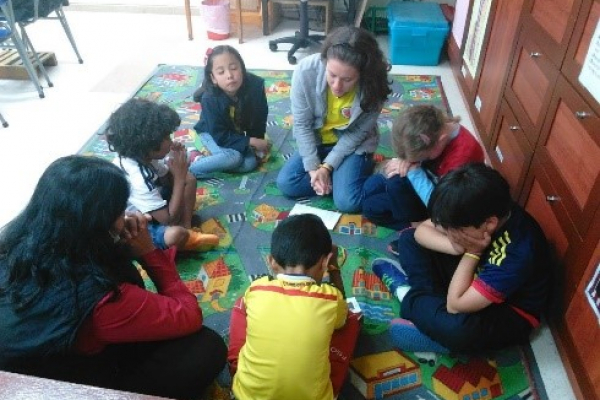
When safeguarding ceases to be simply an institutional document and becomes a living culture %20-%20RESIZED.jpg) of care in the school, its effects go beyond the physical space of the classroom. It shapes the way a student understands himself, God, and the world around him. An environment that protects communicates daily: “You have value. Your voice matters. Your body deserves respect. Your story is taken seriously.” This message, repeated in consistent practices, forms identity.
of care in the school, its effects go beyond the physical space of the classroom. It shapes the way a student understands himself, God, and the world around him. An environment that protects communicates daily: “You have value. Your voice matters. Your body deserves respect. Your story is taken seriously.” This message, repeated in consistent practices, forms identity.
Students who grow up in such an environment develop a healthy self-image. They learn that their dignity does not depend on performance, popularity, or approval, but is rooted in the fact that they are bearers of the imago Dei. This strengthens their self-esteem in a balanced way — not based on pride, but on identity. They come to understand that mistakes do not nullify their value, and that limits are not rejection, but care.
Their perception of God is also deeply impacted. When school leaders protect instead of intimidate, listen instead of silence, and justly correct instead of humiliate, students learn that God is neither abusive nor indifferent. They begin to associate authority with responsible love. Faith is no longer just a religious discourse; it becomes a concrete experience of care. This builds spiritual confidence and reduces the distortions that are often born out of unsafe environments.
Their view of society is also transformed. Students trained in a culture of safeguarding learn that injustice should not be normalized and that vulnerable people should be protected. They understand that neutrality in the face of abuse is essentially complicity, and thus they develop a sense of social responsibility. They learn that their faith has public implications; thus, they grow not only as students, but as conscientious citizens, capable of contributing to safer and more just communities.
In the family environment, these students tend to reproduce what they have experienced. Children and adolescents who learn about healthy limits, mutual respect, and active listening take these values into the home. They begin to recognize inappropriate behavior, to value dialogue, and to understand that love and violence do not go together. Schools, therefore, not only impact individuals — they influence entire systems.
Among peers, the effect is equally transformative. A safe environment teaches empathy and reciprocity. It teaches that the colleague is not a rival to be overcome, but a person to be respected. It reduces the culture of fear and destructive competition, strengthening collaboration, solidarity, and healthy friendships.
By applying safeguarding intentionally and consistently, a school fosters a worldview marked by dignity, responsibility, justice, and compassion. It forms students who know they are loved by God, who understand the value of others, who recognize the importance of limits, and who take a stand against injustice. This is an education that goes beyond tests and report cards; it is education for life.
Educators and schools that embrace this mission are not only preventing harm — they are participating in building a generation that is safer, more upright, and more aware of its role in the world. Safeguarding, when lived as an expression of the Kingdom of God, not only protects students’ present; it broadens their future.
Arite Julia is a Brazilian living in Uruguay. She works in TeachBeyond's Safeguarding Department and on the Language Department's Translation team and provides support for TeachBeyond Uruguay. She loves knitting and quilting.
Photo Credits
Elementary School Kids. Shutterstock. Resized.
Women Serving Food. Shutterstock. Resized.

Your Next Chapter
Stories like this start with
someone saying yes.
Every roof, every classroom, every friendship begin when one person decides to step beyond. We'd love to walk with you as you conside what that might look like.
Related Stories