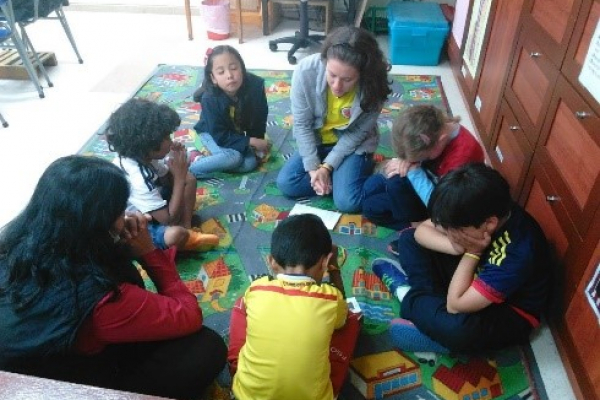
Fostering Class Community

“With God we shall do valiantly…” – Psalm 60:12a[1]
Being intentional to use Scripture to speak life over a classroom has eternal impacts, and so this verse was written over my classroom door a few years ago. The particular class I had at that time was struggling on many fronts (as was I, their teacher). From the start of the year, my goal was to help each one succeed and thrive, and I knew we would only make it with God at our side. I wanted them to know that God cared about each of their lives and struggles because they are made in His image with immeasurable worth, so much so that He let His Only Son die on the cross to pay for their (and my) sins! What a gift – freely given! In addition to focusing my students on God’s care for them, I also make it a point to focus on building a caring class community as a way to help them succeed and thrive. Here are a few ways I do that. While my examples come from a first-grade classroom, the ideas and principles can easily be adapted for older grades.
The core values at our school – integrity, growth, and community – are posted in my classroom, and we reference them regularly. I heavily lean into community from many angles (in modeling, in empathy building, in procedures, in behavior consequence conversations, etc.) because I want my students to know that they are part of a community – a group living life together with a goal in mind. To begin with, we belong to our first-grade classroom community. Then, broader, we have our early grades floor, where other classrooms are connected via one hallway. Then, even broader, it is our whole school world. The circles just continue to grow, and I love watching their understanding of how we are connected to the greater world around us expand as they learn more about how each one plays a part in the community. Building classroom community is where it starts.
I want each student in my room to know they are loved and seen in my classroom. Everyone comes in as a unique individual, and I want them to thrive. In order to do that, I must make time to see them – actually SEE them. I try to have a non-academic-related check-in with each student every 2 weeks (or weekly, if I can manage). I call students individually over to my desk or into the hallway and ask how they are doing, what they did that weekend, tell them how glad I am to see their smile, etc. I think it is especially beneficial to have this type of positive conversation in the hallway, where often the conversation is a negative one stemming from misbehavior. These check-ins redeem that space. I love seeing the smiles on their faces as they get to tell me about something with my undivided attention on them.
Along the same lines, I use a morning greeting chart and start by modeling how to do the morning greeting for several weeks before I turn it over as a classroom job. It offers several choices, so kids have autonomy to choose how much interaction they have first thing in the morning. (Some kids are ready for big and happy, other kids just want to get in the classroom with a nod.) It also allows me to personally see each student as they enter the classroom in the morning. I love when I can turn this over to the students and see how they model their greeting after how they saw me do it! In addition to the morning greeting, we have a variety of other classroom jobs. Some are more “glamorous” (like morning greeter or line leader), so it is important to rotate through them, but it is equally important to teach students that each job has a reason for existing and that even if their job in our community seems small, it has a purpose.
In our social-emotional curriculum, we talk a lot about empathy at the beginning of the school year. We have a “Mood Meter”[2] in the classroom, where students (and the teacher) can check in on the small board showing how they are feeling that day. This allows for good conversations about what emotions are (a signal for something), and it allows me to pursue further conversation with a student who is saying they are struggling that day. The students know that must think carefully and evaluate their own feelings before checking in (not just put their name by their friend’s name or on “happy” because they think it’s the right thing to do). As I teach about the Mood Meter, it allows me to talk more about empathy – recognizing emotions in others. It does not mean that their mood has to affect my mood, but it can mean that I go over to someone who is feeling down and ask if I can help somehow, or if they want to sit with me on the playground. All this builds up the awareness of others outside of yourself  in our community. Ephesians 4:32 encourages us to “be kind to one another, tenderhearted…” and I am always amazed to see my students develop empathy as the school year progresses, noticing each other and in simple, child-like ways, letting each other know they are seen and cared for.
Another intentional way I integrate community is through classroom procedures. I teach procedures thoroughly and intentionally for several months at the beginning of school because students function best when they know what is expected of them. It’s even the simplest of things: like pushing in your chair when you stand up (because we have a small room and we need to make sure our friends can get through), moving clockwise around our room (to create a flow so that our friends are not bumping in to each other), checking our voice volume (because our friends might be working on a hard test – in our room or in a neighboring room), closing a marker before leaving our seat (so that we don’t get ink on our friends or our resources as we move around), using a chime as an immediate clean-up cue (so that we don’t waste time or cause extra noise from talking and can be ready to learn the next thing). So many procedures naturally affect others, so having things in place to make the day go as smoothly as possible is a huge blessing. We regularly celebrate as a class what has been successful, and even when something did not work and we learned how to navigate a “big flop”. This shows that growth mindset is the focus and not a pass/fail, grade-based mindset.
The final connection to community in my classroom is with consequences. I regularly point out connections of specific actions to their related consequences in the world around us, in books we are reading (Ramona the Pest as our beginning of the year read aloud), and in Bible stories we learn. We talk about how continuing to not push in your chair has a consequence – our friend might fall and get hurt. Or how running down the hallway has a consequence – we might run into someone walking out of another classroom and both get hurt. Even if we did not mean for it to happen (an accident), we are still not free from the consequences of our choices. This allows me to have deep conversations with students about misbehavior in a grander scheme of things (how it affects not only ourselves but also those around us). This is never to shame them, only to have them understand that our choices have consequences that often affect more people than we realized. Just like we are not condemned in Christ, our sins still had/have a consequence – but the story does not end there. Instead, we can receive LIFE from the One Who paid the penalty for our sins (Romans 8:1-4).
The relationship I have built with them over the school year of intentionally engaging with them reminds them that I care. It does not mean it is easy, but it is worthwhile, and it also has eternal impact. One blessing of being here for 8 years is seeing students I taught in first grade grow up and love the community around them!
Hannah Hocutt
Hannah is a first grade teacher at the International Christian School of Budapest (ICSB). She has worked there for 9 years and had 5 years of teaching experience in Alabama before moving overseas. Hannah is a TCK, having grown up in Central and South America, and loves the rich and diverse tapestry of living and teaching cross-culturally. Hannah also enjoys being outside – specifically hiking and running – and coffee shops.
[1] Scripture quotations are from the ESV® Bible (The Holy Bible, English Standard Version®), © 2001 by Crossway, a publishing ministry of Good News Publishers. ESV Text Edition: 2025. The ESV text may not be quoted in any publication made available to the public by a Creative Commons license. The ESV may not be translated in whole or in part into any other language. Used by permission. All rights reserved.
[2] The “Mood Meter” was developed by Marc Brackett, the director of the Yale Center for Emotional Intelligence. You can download a version at https://marcbrackett.com/how-we-feel-app-3/.
Photo Credits
Group of Students. Shutterstock. Resized.
Group of Teenage Students. Shutterstock. Resized.

Your Next Chapter
Stories like this start with
someone saying yes.
Every roof, every classroom, every friendship begin when one person decides to step beyond. We'd love to walk with you as you conside what that might look like.
Related Stories